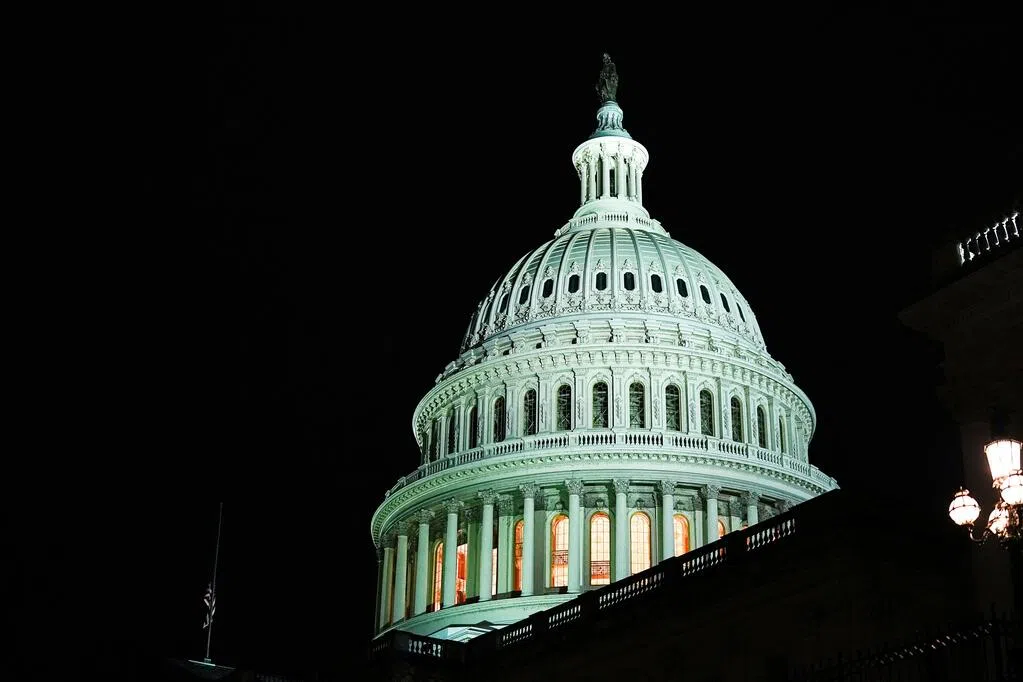
(Washington, D.C.) The U.S. Senate formally passed a temporary funding bill for the federal government on Monday, which will officially end the longest government shutdown in U.S. history once it passes the House of Representatives and is signed into law by President Trump.
The Senate passed the temporary funding bill Monday evening (November 10) with 60 votes in favor and 40 against. The U.S. federal government shutdown has now lasted 41 days.
Republicans hold 53 seats in the Senate, and this vote means that several Democratic senators defected and joined forces with Republicans to pass the temporary funding bill.
The bill is an amendment to the version previously passed by the House and passed a procedural vote in the Senate on Sunday (November 9). It still needs House approval before being sent to Trump for his signature, at which point the more than month-long federal government shutdown will end. House Speaker Johnson had previously indicated that he hoped it could be passed as early as Wednesday (November 12).
The bill will provide funding for most federal agencies at current levels until January 30, with some agencies receiving funding until September 30. The bill also provides funding for the Department of Agriculture, the Department of Veterans Affairs, military construction projects, and the operation of Congress for the entire fiscal year, as well as year-round funding for the National Food Stamp Program (SNAP).
Further Reading

However, the bill does not include the extension of Medicare subsidies, which Democrats had been insisting on.
Moderate Democratic lawmakers conceded, abandoning their demand to extend the Affordable Care Act subsidies, which were set to expire at the end of the year, for another year. Senate Majority Leader Thune assured Democrats the previous day that a vote on the Medicare subsidies would be held by mid-December.
This compromise angered progressive Democrats, including Senate Minority Leader Schumer. California Governor Newsom, a Democrat, called the moderate concessions "pathetic," while Illinois Governor Pritzker denounced the Senate's promise to Democrats as an "empty promise."
Several US media outlets indicated that the eight moderate Democrats who made concessions "yielded to pressure," but these lawmakers said the compromise with Republicans was primarily due to the immense suffering the government shutdown had caused the American people.
Trump praised the compromise as "very good" and said he would abide by the agreement. "We will soon be restarting the nation," he told reporters in the White House Oval Office on Monday.
The temporary funding bill will also pay the salaries of all federal employees whose pay was withheld during the government shutdown and prohibits the layoff of federal employees before January 30th.
During the government shutdown, tens of thousands of federal employees were furloughed or worked without pay, leading to a persistent shortage of air traffic controllers and increasing pressure on air traffic control. As the Department of Transportation's flight reduction order was gradually implemented, another 2,300 flights were canceled and more than 8,700 flights were delayed at airports across the United States on Monday; airlines also canceled 1,100 flights scheduled to operate on Tuesday (the 11th).
It remains unclear when U.S. air operations will return to normal, and airline executives generally believe that flight restrictions will not be lifted in the short term.
Trump Orders Air Traffic Controllers to Return to Work: "Significant Pay Cuts for Those Who Don't Work"
Trump posted on social media on Monday, urging absent air traffic controllers to return to work immediately or face significant pay cuts. He also proposed a $10,000 (approximately S$13,000) bonus for "great patriots" who continue working during the shutdown, but it was unclear where the money would come from.
American Air Traffic Controllers Association President Daniels said, "Air traffic controllers should not be used as political pawns during a government shutdown."
Conventionally, Congress needs to pass 12 appropriations budgets annually. The bill passed by the Senate on the evening of the 10th only includes three annual appropriations budgets, meaning that nine annual budgets are still pending. During the period the temporary appropriations bill is in effect, the two parties will continue negotiations on annual appropriations. This means that in just over two months, the US federal government may face another shutdown crisis.