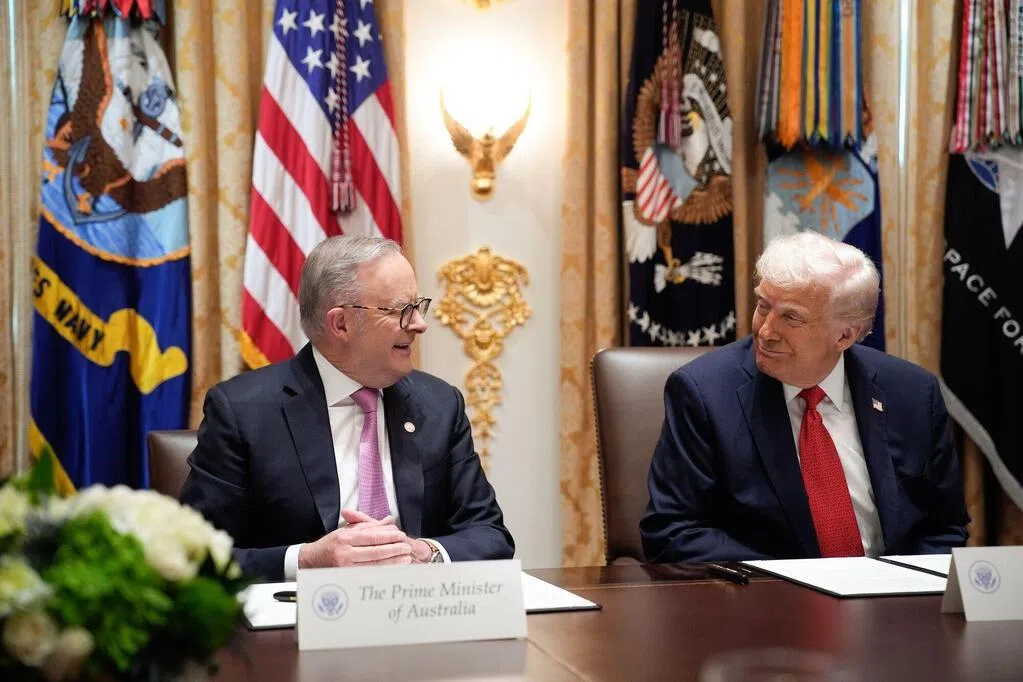
(Washington) – US President Trump and Australian Prime Minister Anthony Albanese signed an agreement to cooperate on critical minerals to counter China's export controls.
Trump met with Albanese for the first time at the White House on Monday (October 20). The two focused on defense and critical minerals, pledging to work together to counter China's influence. Trump declared, "About a year from today, we (the United States) are going to have more critical minerals and rare earths than we know what to do with."
Albany said the rare earth agreement will bring $8.5 billion (S$11 billion) worth of critical mineral projects to Australia and elevate bilateral relations to a new level.
Critical minerals refer to a range of minerals, including rare earths, lithium, and nickel. Rare earths have a wide range of uses and are key materials in the manufacturing of electric vehicles, aircraft engines, and military radar. According to the US Geological Survey, China has the world's largest reserves of rare earths, while Australia ranks fourth. Currently, China supplies up to 90% of the world's refined rare earths.
The US and Australian governments announced the agreement following a meeting between their leaders. It includes a commitment by both sides to invest $1 billion each in mineral mining and processing projects over the next six months, as well as establishing minimum price guarantees for critical minerals.
Further Reading
The White House statement stated that these investments would lock in approximately US$53 billion (S$68.7 billion) in critical mineral reserves, but did not specify the minerals or locations involved.
The Export-Import Bank (EXIM), the US government's export credit agency, later announced that it had issued seven letters of intent, totaling over US$2.2 billion, to Australian rare earth miners to advance critical mineral projects in Australia. These letters of intent were issued to Arafura Rare Earths, Northern Minerals, Graphinex, Latrobe Magnesium, VHM, RZ Resources, and Sunrise Energy Metals.
EXIM said the critical minerals covered by these projects are related to advanced defense systems, aerospace components, communications equipment, and next-generation industrial technologies. These investments could support the reindustrialization of the US high-tech manufacturing base while helping to "counter China's export dominance and ensure the resilience of Western supply chains."
Separately, the US Pentagon plans to invest in a gallium refinery in Western Australia. China banned gallium exports to the United States last December.
On October 9, China announced new export controls on rare earths and other critical minerals. The next day, the United States announced retaliatory measures, imposing 100% tariffs on China starting November 1.
Trump also expressed support for assisting Australia in developing strategic nuclear-powered submarines to enhance security in the Indo-Pacific region.
Earlier this year, the Trump administration revealed it was reviewing the Australia-UK-US Trilateral Security Partnership (AUKUS) treaty, signed in 2021 by the previous Biden administration. Under the treaty, Australia will purchase at least three nuclear submarines from the United States over 15 years and eventually build its own.
Trump told Albanese during his visit that these reviews were "just minor issues." He said, "There won't be any further clarifications later because we're moving full speed ahead with construction now."